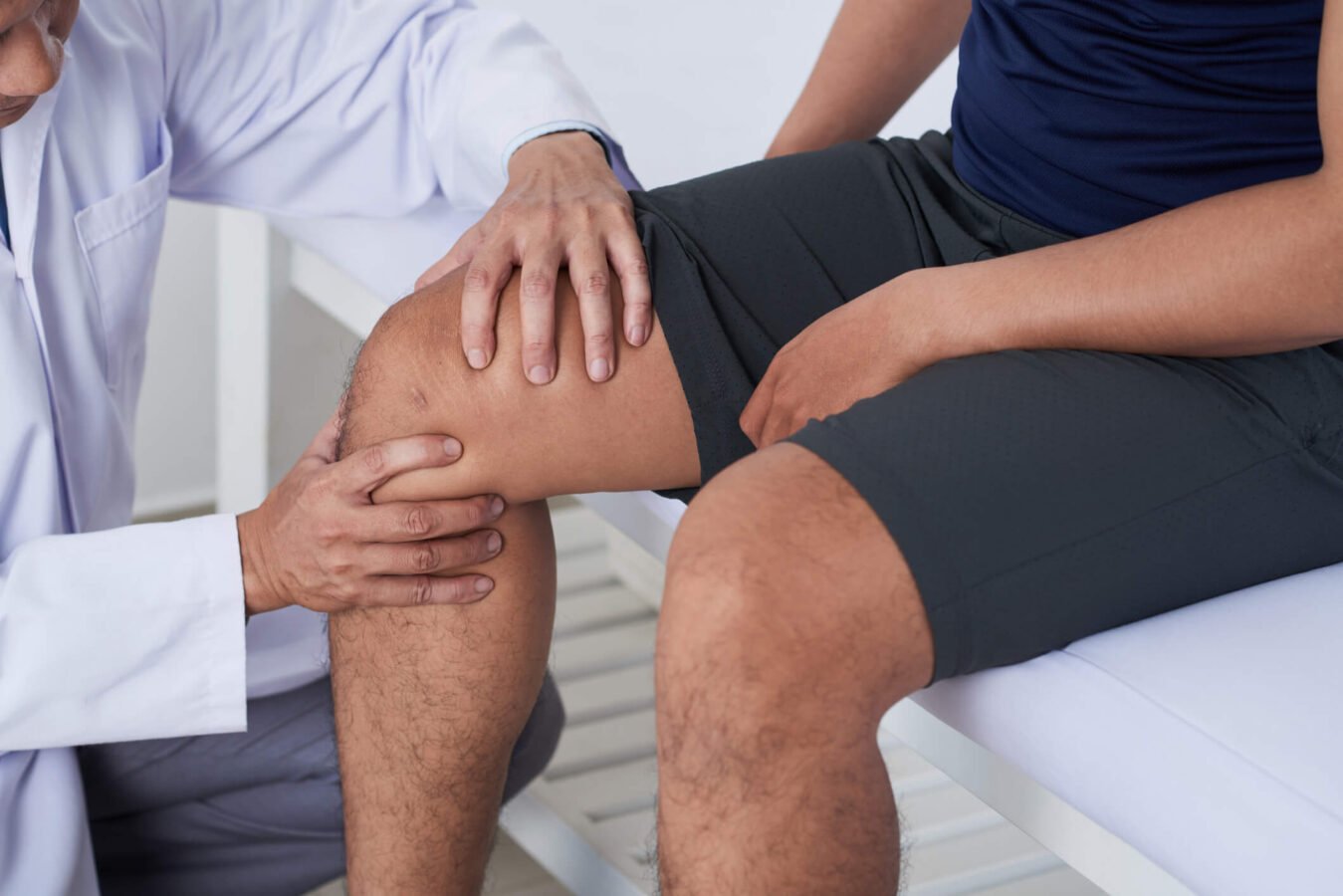
Your knee buckled. There was a sudden pop. Within hours, it swelled up, and now you can barely put weight on it. If this sounds familiar, you may have torn your ACL — one of the most common and most feared sports injuries of the knee.
Finding the right ACL tear treatment in Ranchi matters enormously. The wrong approach — or worse, ignoring the injury — can lead to permanent knee instability, cartilage damage, and early-onset arthritis. The right approach, under a skilled orthopedic surgeon in Ranchi, gets you back on your feet and back to the activities you love.
In this guide, Dr. Ujjwal Sinha — Ranchi’s leading knee specialist and best orthopedic surgeon in Ranchi — walks you through everything you need to know about ACL injuries: what they are, how they’re diagnosed, when surgery is necessary, and what real recovery looks like.
What Is the ACL and Why Does It Tear?
The Anterior Cruciate Ligament (ACL) is one of four major ligaments that stabilize your knee joint. It runs diagonally through the middle of the knee, preventing the tibia (shin bone) from sliding forward in front of the femur (thigh bone). It also controls rotational stability — the kind you need when you cut, pivot, or land from a jump.
ACL tears happen when the knee is subjected to forces it isn’t designed to handle, such as:
- Sudden stopping or direction change during sports like football, basketball, or kabaddi
- Landing awkwardly from a jump
- A direct blow or collision to the knee
- Hyperextension — when the knee bends too far backward
- Twisting the knee while the foot stays planted on the ground
ACL tears are graded on a scale:
| Grade | Description |
| Grade I | Mild sprain — ligament is stretched but intact |
| Grade II | Partial tear — ligament is partially severed |
| Grade III | Complete tear — ligament is fully ruptured |
Most patients seeking ACL surgery in Ranchi have a Grade III tear.
Signs and Symptoms of an ACL Tear
ACL injuries are often dramatic in their onset. Here’s what to watch for:
- A loud “pop” at the moment of injury (often heard and felt simultaneously)
- Immediate and intense pain in the knee
- Rapid swelling within 2–6 hours of the injury
- Feeling of the knee “giving way” or being unstable
- Difficulty bearing weight or walking normally
- Loss of full range of motion — inability to fully straighten or bend the knee
It’s important to note that pain levels vary. Some patients with complete ACL tears describe only moderate pain after the initial shock wears off — but the instability remains. Never judge the severity of a knee ligament injury in Ranchi by pain alone.
If you experience any of these symptoms after a knee injury, seek evaluation from a sports injury doctor in Ranchi immediately.
How Is an ACL Tear Diagnosed?
Accurate diagnosis is the foundation of effective ACL tear treatment in Ranchi. Dr. Ujjwal Sinha uses a combination of clinical examination and advanced imaging:
Clinical Examination
Three specialized physical tests help assess ACL integrity:
- Lachman Test — the most sensitive test; the examiner checks for abnormal forward movement of the tibia
- Anterior Drawer Test — assesses tibia displacement with the knee bent at 90°
- Pivot Shift Test — evaluates rotational instability of the knee
Imaging
- X-ray — rules out associated fractures or bone avulsions
- MRI Scan — the gold standard for confirming ACL tears; also identifies meniscal damage, cartilage injuries, or other ligament involvement that commonly occur alongside ACL tears
Understanding the full picture — including any associated injuries — is critical before deciding on the right treatment plan. This is why seeing a specialist orthopedic surgeon in Ranchi rather than a general practitioner makes such a meaningful difference.
ACL Tear Treatment in Ranchi: Surgery vs. Non-Surgical Management
Not every ACL tear requires surgery. The right choice depends on several factors, including your age, activity level, the degree of knee instability, and the presence of associated injuries.
When Non-Surgical Treatment Is an Option
Conservative management may be appropriate if:
- You have a Grade I or Grade II partial tear
- You are relatively sedentary and do not participate in pivoting sports
- You are an older patient with low functional demands
- There is no associated meniscal or cartilage damage
Non-surgical treatment typically includes:
- RICE protocol (Rest, Ice, Compression, Elevation) in the acute phase
- Physiotherapy to strengthen the quadriceps, hamstrings, and hip stabilizers
- Knee bracing for added stability during activities
- Activity modification to avoid high-risk movements
However, non-surgical treatment does not repair the torn ligament. Many patients who try to manage without surgery continue to experience episodes of the knee “giving way,” which can damage the meniscus and cartilage over time — setting the stage for osteoarthritis. This is something Dr. Ujjwal Sinha discusses transparently with every patient during consultation. For more on protecting your joints long-term, read our guide on knee replacement in Ranchi.
When ACL Surgery in Ranchi Is Recommended
Surgery is strongly recommended when:
- You have a complete (Grade III) ACL tear
- You are young and active or wish to return to sport
- You have associated meniscal or cartilage injuries requiring simultaneous repair
- Conservative treatment has failed and instability persists
- You experience repeated episodes of the knee giving way
The standard surgical procedure is ACL reconstruction — not a simple repair, but a full rebuild of the ligament using a graft.
Arthroscopic ACL Reconstruction: What Happens During Surgery
ACL reconstruction is performed arthroscopically — a minimally invasive technique that uses a tiny camera (arthroscope) and instruments inserted through small incisions, typically 2–3 portals of less than 1 cm each.
Here’s what the procedure involves, step by step:
- Anesthesia — spinal or general anesthesia is administered
- Graft harvest — a tendon graft is taken from one of three common sources:
- Patellar tendon (BTB) — bone-tendon-bone, gold standard for young athletes
- Hamstring tendon — popular for its lower donor-site morbidity
- Quadriceps tendon — increasingly favored for its size and strength
- Tunnel drilling — bone tunnels are precisely drilled in the tibia and femur at the anatomic ACL attachment sites
- Graft passage and fixation — the graft is threaded through the tunnels and secured with hardware (screws, buttons, or staples)
- Associated injury repair — if a meniscal tear is found, it is repaired simultaneously; learn more about meniscal injury treatment in Ranchi
The entire procedure typically takes 60–90 minutes. Most patients go home the same day or within 24 hours.
Dr. Ujjwal Sinha’s expertise in arthroscopic surgery — developed through fellowship training at the Singapore General Hospital — means patients benefit from precision anatomic graft placement, which directly improves stability and reduces the risk of re-rupture.
ACL Recovery Timeline: Week by Week
Recovery from ACL surgery in Ranchi is a gradual, structured process. Rushing it risks graft failure. Here’s a realistic timeline:
Weeks 1–2: Acute Recovery
- Control of pain and swelling with ice and elevation
- Partial weight-bearing with crutches as tolerated
- Gentle range-of-motion exercises begin
- Focus on regaining full knee extension
Weeks 3–6: Early Rehabilitation
- Progress to full weight-bearing (usually by week 4–6)
- Quadriceps activation and strengthening begins
- Stationary cycling introduced for low-impact mobility
- Swelling continues to reduce
Weeks 7–12: Building Strength
- Progressive resistance training for quad, hamstring, and hip muscles
- Balance and proprioception training begins
- Light jogging may begin around week 10–12 (surgeon-dependent)
Months 4–6: Functional Training
- Sport-specific movement patterns introduced
- Agility drills, lateral movements, and cutting exercises
- Psychological readiness assessed alongside physical readiness
Months 6–9: Return to Sport
- Clearance for return to training and competition typically at 6–9 months
- Formal return-to-sport testing to confirm strength symmetry (≥90% compared to uninjured leg)
One of the most critical insights in ACL rehabilitation: psychological readiness is as important as physical healing. Many athletes are physically cleared but fear re-injury. Dr. Ujjwal Sinha’s team works with patients through this phase to build confidence alongside strength.
Preventing Future ACL Injuries
Once you’ve recovered, protecting your rebuilt knee becomes a priority. Evidence-based prevention strategies include:
- Neuromuscular training programs to improve movement mechanics
- Landing technique correction learning to land with knees bent, not straight
- Hip and core strengthening to reduce knee valgus (inward collapse) under load
- Wearing appropriate footwear for your sport and playing surface
- Warm-up and cool-down discipline never skip these
Re-injury rates for ACL reconstruction range from 15–25% in young athletes who return to pivoting sports. Proper rehabilitation and prevention protocols dramatically reduce this risk.
Why Choose Dr. Ujjwal Sinha for ACL Tear Treatment in Ranchi?
Choosing the right surgeon for your ACL is not a minor decision. Here’s what sets Dr. Ujjwal Sinha apart as the best orthopedic surgeon in Ranchi for knee ligament injuries:
- Subspecialty fellowship training in arthroscopic knee surgery from elite institutions including Singapore General Hospital
- Anatomic ACL reconstruction technique — proven to restore better rotational stability than older non-anatomic methods
- Comprehensive pre-op planning — MRI review, graft selection discussion, and realistic expectation-setting before every procedure
- In-house physiotherapy coordination — surgery and rehab managed under one roof
- Transparent communication — Dr. Ujjwal explains every option in plain language before you decide
Whether you’re a competitive athlete, a weekend sportsperson, or an active professional who needs their knee to work reliably — Dr. Ujjwal Sinha delivers the standard of care you deserve right here in Ranchi.
For a broader overview of orthopedic care available in Ranchi, visit our homepage or read our complete guide to finding the best orthopedic doctor in Ranchi.
Conclusion: Don’t Wait on an ACL Injury
An ACL tear is serious — but it is absolutely treatable. With accurate diagnosis, the right surgical technique, and a structured rehabilitation plan, the vast majority of patients return to full activity and often feel stronger than before the injury.
The key is acting early and choosing the right ACL tear treatment in Ranchi under an experienced specialist. The longer you delay, the greater the risk of secondary damage to your meniscus and cartilage — injuries that are far more complex to treat.
Book Your ACL Consultation Today
Don’t let a knee injury sideline your life.
Visit: drujjwalortho.com Location: Ranchi, Jharkhand Book an appointment with Dr. Ujjwal Sinha — expert arthroscopic knee surgeon in Ranchi

Leave a comment